

Affiliate disclosure: This article contains a promotional link. If you purchase through that link, the publisher may receive a commission at no additional cost to you. Product specifications, prices, availability, promotions, installation requirements, and warranty terms can change. Confirm every current detail on the merchant’s website before ordering.
Ceiling fans have a simple job: move air so a room feels more comfortable. Yet anyone who has lived with a fan that hums, wobbles, clicks, or barely reaches the other side of the room knows that the job is not always done well. In a bedroom, poor performance can interrupt sleep. In a great room, it can make an expensive HVAC system work harder than necessary. On a covered patio, the wrong fan can turn the best part of the home into a place people avoid during warm months.
That is why a ceiling fan should be treated as more than a decorative finishing touch. It is part of how a space works. The right size, airflow design, motor, mounting setup, and controls can make an indoor room feel calmer, a covered outdoor area more usable, and a large commercial environment more comfortable for employees and visitors.
Big Ass Fans has built its name around high-performance airflow products for homes, businesses, and industrial environments. Its residential range includes smart ceiling fans such as Haiku and Haiku L, as well as larger indoor and outdoor options. The wider catalog also includes commercial and industrial high-volume, low-speed (HVLS) fans, evaporative cooling products, wall-mounted and portable fans, and other solutions for spaces where ordinary ceiling fans are not enough.
This guide explains how to choose a Big Ass Fan without getting distracted by marketing language. You will learn how to match fan diameter to room size, evaluate smart features, select the right outdoor rating, choose a downrod, and decide when a large-format fan makes sense. It also includes a practical comparison of common use cases, from quiet bedrooms and living rooms to patios, workshops, gyms, warehouses, and event spaces.
Browse Big Ass Fans’ current models, configurations, and offers here.
Why airflow deserves more attention in home and workplace design
Air movement changes how people experience temperature. A fan does not lower the room’s actual air temperature in the way an air conditioner does, but moving air across the skin can make an occupied space feel more comfortable. That perceived cooling effect can make a meaningful difference in everyday life, particularly in rooms with sun exposure, high ceilings, warm sleeping conditions, or limited cross-ventilation.
The effect is not only about summer. During cooler periods, a carefully used ceiling fan can help circulate air in rooms where warm air gathers near the ceiling. The exact benefit depends on the layout, heating system, ceiling height, and fan direction, so it is wise to follow the manufacturer’s instructions and use an HVAC professional for a complicated environment. Still, the principle is useful: comfort depends on air movement as well as thermostat settings.
In workplaces, the case can be even clearer. Employees in a warehouse, gym, workshop, distribution center, restaurant patio, or event venue may spend hours in large spaces where conditioned air is hard to distribute evenly. An airflow plan that works in a small bedroom will not necessarily work under a thirty-foot ceiling. This is where commercial and industrial fan design becomes a performance question rather than a décor question.
Big Ass Fans approaches that question with products designed for different scales. The name is memorable, but the most important part of the brand proposition is the focus on airflow engineering, motor design, and formats ranging from refined residential fans to very large HVLS solutions. The goal for the shopper is to identify the job before choosing the product.
What Big Ass Fans offers
Big Ass Fans is not a one-model ceiling-fan brand. Its current website presents product categories for residential indoor fans, outdoor fans, commercial fans, industrial HVLS fans, and cooling products. On the residential side, shoppers can explore premium models including Haiku, Haiku L, i6, es6, Bison, Mammoth, and others depending on the market and configuration. Product availability changes, so use the live store to see the current line-up in your region.
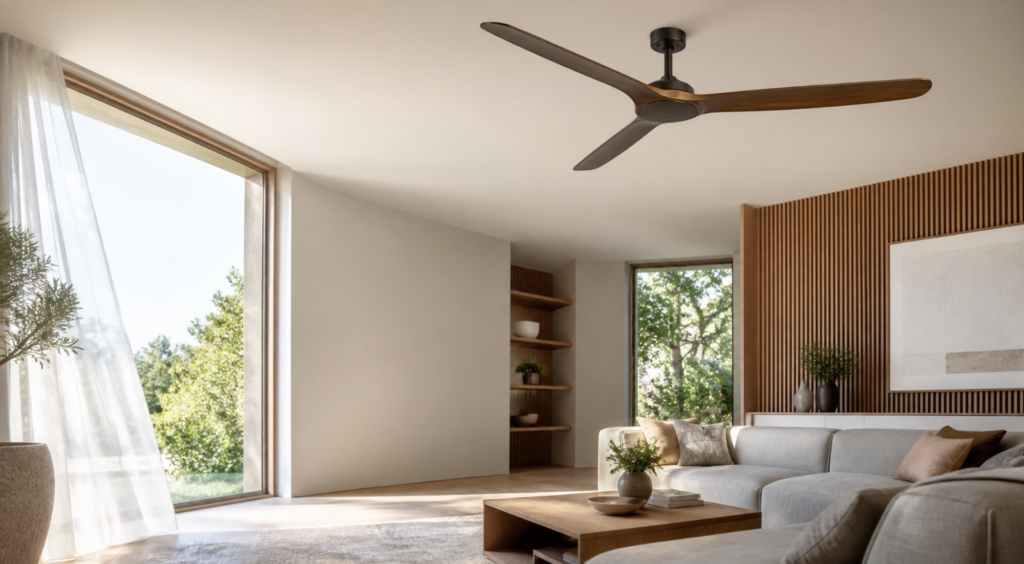
The Haiku range is one of the best-known parts of the catalog. Big Ass Fans positions Haiku as a design-led smart fan with options such as Moso bamboo or aluminum airfoils, a brushless permanent-magnet motor, app and voice-control compatibility, and automated comfort features in eligible configurations. Haiku models come in different diameters and are designed for particular indoor or covered-outdoor applications. The brand’s current Haiku page lists options such as 52-inch, 60-inch, and 84-inch diameters, with room-size guidelines attached to each. Those guidelines are a useful start, but they do not replace measurement and installer input for unusual rooms.
Haiku L is designed as a more accessible route into the same design family. The i6 and es6 lines provide larger-scale or more industrial-influenced styling, while models such as Mammoth and Bison are aimed at robust outdoor use cases. For exterior applications, the installation environment is the first consideration: a fan approved for a covered, damp location is not automatically suitable for direct rain, salt air, or severe weather exposure.
Beyond residential products, Big Ass Fans is known for large-format airflow equipment. HVLS fans use large diameters and relatively slow rotation to move substantial amounts of air through big spaces. They are commonly considered for facilities such as warehouses, manufacturing areas, sports venues, agricultural buildings, and large retail spaces. Choosing these products should involve professional planning because ceiling clearance, electrical supply, safety requirements, building use, and airflow goals all matter.
The Big Ass Fans difference: what to look for beyond the name
When comparing premium ceiling fans with low-cost alternatives, focus on the factors that affect your experience every day. A fan can look attractive in a product photograph while still being poorly suited to the room. Conversely, a well-chosen premium fan can feel like a lasting part of the home rather than an appliance you tolerate.
Quiet, balanced operation
Noise is often the hidden cost of a cheap fan. A faint click may be tolerable in a garage, but it can be frustrating above a bed, a desk, or a dining table. Wobble is also more than a cosmetic annoyance. It can affect perceived quality, create noise, and make people worry about the installation.
Big Ass Fans says that its Haiku airfoils are precision balanced and that each fan is tested before shipping. Its current Haiku product page describes operation at under 35 dBA at maximum speed for the model shown, while noting airflow capability up to 17,369 CFM. Product figures depend on the configuration and may change, so confirm the exact model’s documentation. The larger lesson is universal: seek published sound and airflow information where available, and do not judge a fan solely by blade count or motor wattage.
Motor and efficiency considerations
Many modern premium fans use brushless DC or EC motor technology. Such motors can be valued for quiet operation, low-speed efficiency, and fine speed control. On the current Haiku page, Big Ass Fans describes a brushless DC/EC permanent-magnet motor that can draw as little as 2.4 watts at low speed. That is a product-specific manufacturer claim, not a prediction of your home’s energy use, but it illustrates why the motor type and control system deserve attention.
Efficiency is not just a utility-bill talking point. A fan that is pleasant to run at a low or medium speed is more likely to be used consistently. That can make a space feel comfortable without defaulting immediately to a lower thermostat setting. Actual savings will vary with climate, HVAC equipment, home insulation, behavior, electricity rates, and local conditions, so treat energy claims as a reason to compare—not a guaranteed financial outcome.

Smart controls and automation
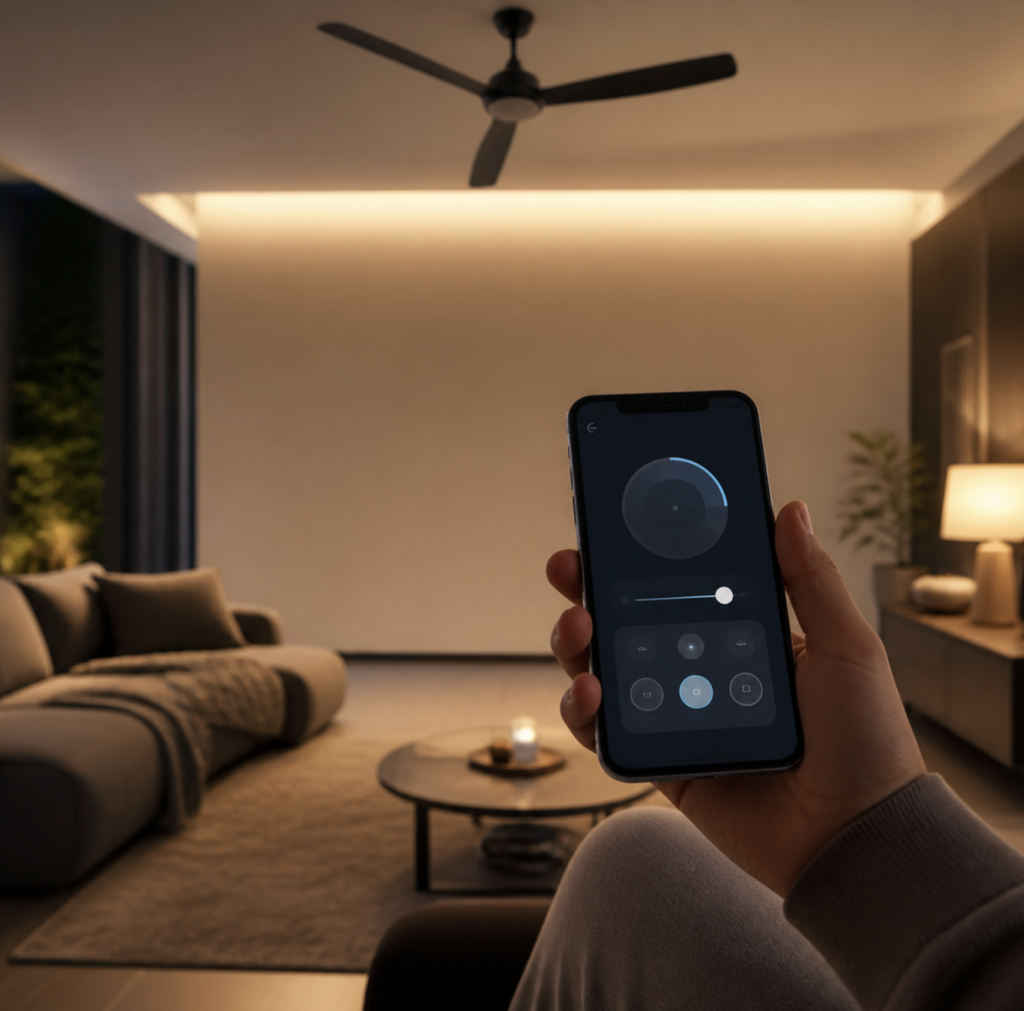
Smart control can be genuinely useful when it reduces friction. A fan that can be adjusted from a wall control, handheld remote, app, or voice assistant can be easier to use in a tall room or a large open plan. Big Ass Fans states that certain Haiku configurations support control through its app, Bluetooth wall control, handheld remote, and integrations with Apple HomeKit via Matter, Amazon Alexa, Google Home, and Ecobee. Compatibility can vary by product and update over time, so check the exact configuration before buying.
The brand’s SenseMe feature is intended to use temperature and motion sensing to adjust fan operation based on room conditions and occupancy. For the right person, this can be a convenience feature: set preferences once, then allow the fan to respond automatically. For someone who prefers simple manual control, it may be less important. Buy smart features because they solve a real workflow problem, not because they sound futuristic.
Materials and finish
A ceiling fan is highly visible, especially in rooms with low ceilings or open layouts. Big Ass Fans offers design-oriented finishes and, on selected models, aluminum or Moso bamboo airfoils. Material choice affects appearance, maintenance expectations, and suitability for the installation environment. An indoor bamboo-look finish may be perfect in a living room but inappropriate for a weather-exposed structure. Read the product rating and care guidance instead of assuming that a stylish finish is universal.
How to choose the right ceiling fan size
The most common fan-shopping mistake is buying too small. A compact fan may be visually subtle, but it can look lost in a large room and fail to distribute air across the occupied area. On the other hand, a large fan in a cramped room can feel out of scale and may not have proper clearance.
Begin by measuring the room’s length and width, then note the ceiling height, furniture layout, window placement, and where people actually sit or sleep. A long narrow room behaves differently from a square room with the same square footage. A room with a vaulted ceiling, fireplace, or extensive glass may need more careful planning.
Big Ass Fans’ current Haiku guidance gives a helpful example of model-specific sizing: a 52-inch diameter is listed for rooms up to 225 square feet, a 60-inch diameter for rooms up to 400 square feet, and an 84-inch diameter for rooms up to 900 square feet. These are estimates, not laws. The brand also advises sizing up for outdoor, unusually shaped, or very tall spaces. That advice makes intuitive sense because airflow has farther to travel and exterior areas are affected by open boundaries and ambient conditions.
Use these questions during selection:
- What is the true usable area, not just the home’s total square footage?
- Is the room square, long, open to another room, or divided by beams?
- Is the fan for sleeping, dining, working, exercising, or entertaining?
- Is the ceiling flat, sloped, low, or unusually tall?
- Will furniture placement put people directly under the fan or farther away?
- Does the fan need to be suitable for a covered outdoor area?
For a large, irregular, or high-ceiling room, consider a design consultation or speak with a qualified installer. This is particularly important if you are choosing a large-diameter fan. Correct placement and clearance are part of both performance and safe installation.

Downrods and ceiling height: the detail that changes performance
The downrod is the rod that positions a ceiling fan below the ceiling. It is easy to overlook, yet it influences airflow, visual proportion, and clearance. A fan mounted too close to a high ceiling can struggle to distribute air effectively into the occupied zone. A fan mounted too low may create a safety issue or look awkward.
Big Ass Fans’ current Haiku guide offers downrod estimates by ceiling height: seven inches for approximately eight-to-nine-foot ceilings, twelve inches for nine-to-ten-foot ceilings, twenty inches for ten-to-eleven-foot ceilings, and progressively longer lengths for higher ceilings. Treat these as starting points. Ceiling slopes, beams, sprinkler systems, lighting fixtures, and local building requirements can change the answer.
In general, many residential installations aim to keep fan blades well above the floor and at a comfortable height below the ceiling. Local codes and manufacturer instructions take precedence. If you are not familiar with ceiling-fan electrical installation, hire a qualified professional. The work may involve a properly rated electrical box, secure mounting, wiring, balancing, and testing. A premium fan deserves a premium installation.
Indoor vs. outdoor: choosing the correct environmental rating
“Outdoor ceiling fan” can mean different things, which is why the rating matters. A dry-rated fan is designed for indoor dry locations. A damp-rated fan can be suitable for protected spaces such as covered porches, sunrooms, and patios with overhead protection. A wet-rated fan is designed for direct exposure to rain and other wet conditions, subject to the manufacturer’s instructions.
Never assume that a fan labeled “outdoor” can go anywhere outside. Big Ass Fans describes its Haiku Outdoor ceiling fan as damp-rated for covered patios, porches, and sunrooms in moderate climates. It is built for covered outdoor spaces, not necessarily for direct rain or highly corrosive coastal conditions. The product range also includes specialized options, including a Haiku Coastal marine-grade outdoor model in the current catalog. The right product depends on the actual environmental exposure.
Before ordering, inspect the site rather than relying on a broad label. Is the roof solid and deep enough to shield the fan from wind-driven rain? Is the fan close to a pool, ocean, hot tub, or grill? Does the area experience salt air, freezing weather, extreme humidity, or heavy dust? Is the electrical connection protected? These details affect long-term durability and should be discussed with an installer if there is any uncertainty.
A practical guide to Big Ass Fans models and use cases
The best way to navigate a broad catalog is to choose the space first. Here are common situations and the features to prioritize.
Bedroom or home office
Prioritize quiet operation, smooth speed control, a diameter that matches the room, and controls you can use easily without leaving bed or a desk. An app or remote can be convenient, but a dependable wall control may be equally important. A modern Haiku or Haiku L configuration may appeal to shoppers who value low-noise operation and minimalist design. If the room is small, do not assume the largest model is better; clearance, bed location, and scale still matter.
Living room or open-plan great room
Look for airflow reach, scale, and a finish that complements the room. Open plans often require more careful sizing because air can disperse into adjacent spaces. An 84-inch model may be worth considering for an appropriately sized large room, while a smaller model may be better in a more compact living area. Smart controls can be valuable when the fan is mounted high or serves a frequently used multi-purpose room.
Covered patio, porch, or sunroom
Start with the rating. For a covered space, a damp-rated fan may be appropriate if the product documentation and the actual level of protection align. Airflow matters because the space is partly open, so Big Ass Fans’ advice to consider sizing up for outdoor settings is useful. Choose materials and finishes suited to the environment, then think about lighting, remote control, and how the fan will coexist with screens, heaters, and furniture.
Outdoor kitchen or entertainment area
This is a design-and-function application. People gather, food is prepared, and the fan may need to operate for long stretches. Prioritize the correct outdoor rating, durable materials, a scale that fits the roofline, and easy controls. If the space is exposed to salt air or direct rain, do not settle for an indoor or merely damp-rated fan. Ask about products designed for that exposure.
Workshop, garage, or home gym
Durability and useful air movement may matter more than ornamental finish. Consider ceiling height, dust, equipment placement, electrical access, and safety clearance. A large ceiling fan can make a home gym feel more usable in warm weather, while a powerful wall-mounted or portable option may suit a workshop layout better. The goal is to move air where people work, not simply to fill empty ceiling space.
Commercial, industrial, or agricultural facility
This category needs a project-based approach. Large spaces involve operational demands, employee comfort, equipment heat, building geometry, code requirements, and possibly complex installation. Big Ass Fans’ HVLS products are designed for these types of conditions, but professional assessment is essential. Gather ceiling height, facility dimensions, obstructions, electrical details, and the desired coverage area before requesting a quote or proposal.
Smart-fan features: useful convenience or unnecessary complexity?
Smart home features can be valuable, but they are not automatically a reason to pay more. Start by considering how you live. If you already use HomeKit, Alexa, Google Home, or Ecobee and want the fan to participate in routines, compatibility may be a major benefit. For example, you might want the fan to slow during a movie, switch off when a room is vacant, or start at a gentle speed before bedtime.
Big Ass Fans says select Haiku products work with these smart-home ecosystems and can be controlled through its mobile app. The brand also promotes sensor-driven automation through SenseMe. Verify current integration support, home-network requirements, and any optional components before purchase. Smart-home standards evolve, and the product page for the exact model should be the source of truth.
For buyers who value simplicity, a remote and wall control may provide all the convenience needed. There is no wrong answer. The best control system is the one your household or workplace will actually use. A beautifully engineered fan with confusing controls can still become an ignored appliance.
Does a premium ceiling fan make sense for your budget?
Premium ceiling fans cost more than basic hardware-store models, so the decision should be practical. Consider the total cost of ownership rather than the box price alone. This includes installation, reliability, expected years of use, noise, airflow quality, energy use, appearance, maintenance, and the risk of needing replacement.
For a rarely used spare room, a simple fan may be enough. For a primary bedroom, living room, main patio, hospitality setting, or visible architectural feature, a premium fan may be easier to justify. You will notice its sound, balance, controls, and appearance frequently. In a commercial setting, comfort and operational utility can carry even more weight.
Big Ass Fans’ current ceiling-fan catalog lists different prices by model and configuration, and occasional sale pricing may appear. Do not base an article, renovation budget, or purchase decision on a single published price. Use the live product page to configure diameter, finish, downrod, lighting, and other options, then check current terms. For commercial projects, request a tailored quote instead of treating a residential product price as a benchmark.
Installation, maintenance, and safety essentials
A ceiling fan can perform only as well as it is installed. Follow the manufacturer’s instructions, use the correct ceiling-fan-rated electrical box, and use a qualified electrician or installer when you are not experienced with electrical and overhead-mounting work. This is especially important for heavier or larger models, outdoor installations, sloped ceilings, and spaces with structural or electrical complexity.
Before installation, confirm:
- The chosen model is rated for the environment.
- The ceiling structure and electrical box are suitable for the product’s weight and mounting method.
- The downrod and mounting style are correct for ceiling height and slope.
- Blade clearance from walls, beams, lights, sprinklers, doors, and furniture meets the product instructions and applicable codes.
- Controls, switches, and smart-home connections have been planned before final installation.
For maintenance, dust airfoils gently according to the product’s care guide, check for unusual noise or looseness, and do not ignore a sudden wobble. A new vibration can indicate a balance, mounting, or hardware issue that deserves attention. Do not climb ladders or attempt electrical repairs if you are not comfortable doing so safely.
Frequently asked questions about Big Ass Fans
Are Big Ass Fans only for commercial or industrial buildings?
No. The brand is known for large commercial and industrial fans, but it also sells residential ceiling fans and outdoor options. The Haiku family is particularly associated with design-focused home applications. The right category depends on the size, use, and conditions of your space.
Which Big Ass Fan is best for a bedroom?
The best choice depends on room size, ceiling height, desired finish, lighting needs, and your preference for smart features. In general, prioritize quiet operation and correct sizing. Haiku and Haiku L models are commonly considered for residential rooms, but verify the current model specifications before ordering.
Is a 52-inch, 60-inch, or 84-inch fan right for my room?
Use the manufacturer’s current room-size guidance as a starting point. On the current Haiku page, Big Ass Fans lists 52 inches for rooms up to 225 square feet, 60 inches for rooms up to 400 square feet, and 84 inches for rooms up to 900 square feet. Room shape, ceiling height, outdoor exposure, and furniture layout can change the recommendation, so measure carefully and consult an installer for unusual spaces.
Can a Big Ass Fan be installed outside?
Some models are intended for covered outdoor or outdoor use, but the environmental rating is essential. A damp-rated model is not necessarily suitable for direct rain. Check the exact product’s instructions and match them to the exposure of your patio, porch, or other location.
Do Big Ass Fans work with smart-home systems?
Big Ass Fans states that select models support app, voice, and smart-home controls, including integrations with Apple HomeKit via Matter, Amazon Alexa, Google Home, and Ecobee. Compatibility can vary by product, market, and software updates. Always confirm the current product page for the exact configuration.
What is an HVLS fan?
HVLS means high-volume, low-speed. These fans use a large diameter and lower rotational speed to circulate substantial amounts of air across large spaces. They are commonly used in commercial, industrial, agricultural, and sports facilities. Selecting one typically requires professional planning and installation.
The bottom line: choose for the space, then choose the features
Big Ass Fans is worth considering when airflow, quiet operation, design, and scale matter more than buying the lowest-priced fan available. Its residential offerings give homeowners options for bedrooms, great rooms, covered patios, and outdoor living areas. Its commercial and industrial products broaden the conversation to warehouses, gyms, workshops, and other large spaces where airflow must be planned rather than improvised.
The best shopping strategy is straightforward. Measure the space. Identify the environment and required rating. Consider ceiling height and downrod length. Decide how much you value smart control, lighting, finish, and quiet operation. Then compare the current product documentation for the exact model rather than assuming every fan in a product family has the same specifications.
If you are ready to explore the current selection, configurations, and live pricing, use the official store through the link below. Visit Big Ass Fans here.