

For most of the twentieth century, underwear was invisible by design. It came in white, grey or navy, it was sold in plastic three-packs next to the socks, and the only time anyone thought about it was when it wore out. Then a handful of brands decided underwear could be something else: a canvas, a statement, a piece of culture.
One of the most interesting of them came not from a fashion house in New York or Paris, but from a surf town in Southern California. Ethika grew up alongside skateboarders, motocross riders and surfers, and it built a following by treating boxer briefs the way those communities treat skate decks and sneakers: as something to collect, show off and identify with.
This is the story of how that happened, what made it work, and what it tells us about how streetwear, action sports and everyday basics have come together. Whether you’re a fan of the brand, curious about streetwear culture, or interested in how small brands build loyal communities, there’s a lot to learn from it.
Born in a surf town
Ethika was founded in 2001 in San Clemente, California (Wikipedia). If you know Southern California, the location says a lot. San Clemente sits on the coast of Orange County, between Los Angeles and San Diego, in a stretch of coastline that has shaped surf, skate and motocross culture for decades. Many action sports brands have roots in this region, and the culture there blends athletic obsession with a strong sense of style.
Founder Malcolm McCassy saw a gap in a very ordinary product. Underwear for active people tended to be either purely functional, like athletic compression shorts, or purely basic. There was little that worked hard during a day of riding and also had the attitude of the scene around it. Ethika set out to fill that space: underwear built for movement, with the “cool factor” of the culture it came from.
A short history of underwear going public
To appreciate what Ethika did, it helps to see how underwear changed over the past few decades.
- The era of basics. For generations, underwear was a commodity. It came in a handful of colors, was sold in multipacks, and was chosen on price and habit. Nobody expected it to say anything about them.
- The logo waistband. In the 1980s and 1990s, designer fashion brands turned the waistband into a billboard. A visible logo above your jeans became a status signal, and underwear ads became cultural moments in their own right.
- The performance shift. Around the same time, athletic brands introduced compression shorts and moisture-wicking fabrics, and active people started to expect underwear that worked as hard as their sports gear.
- The self-expression era. Through the 2000s and 2010s, streetwear and action sports brands combined those threads: performance fabrics, visible waistbands and bold graphics. Underwear became a place for personality, not just function or status.
Ethika sits squarely in that last wave. It took the performance expectations of athletes, the visibility of the logo waistband era, and the graphic sensibility of skate culture, and rolled them into one product.
From stickers to the X Games
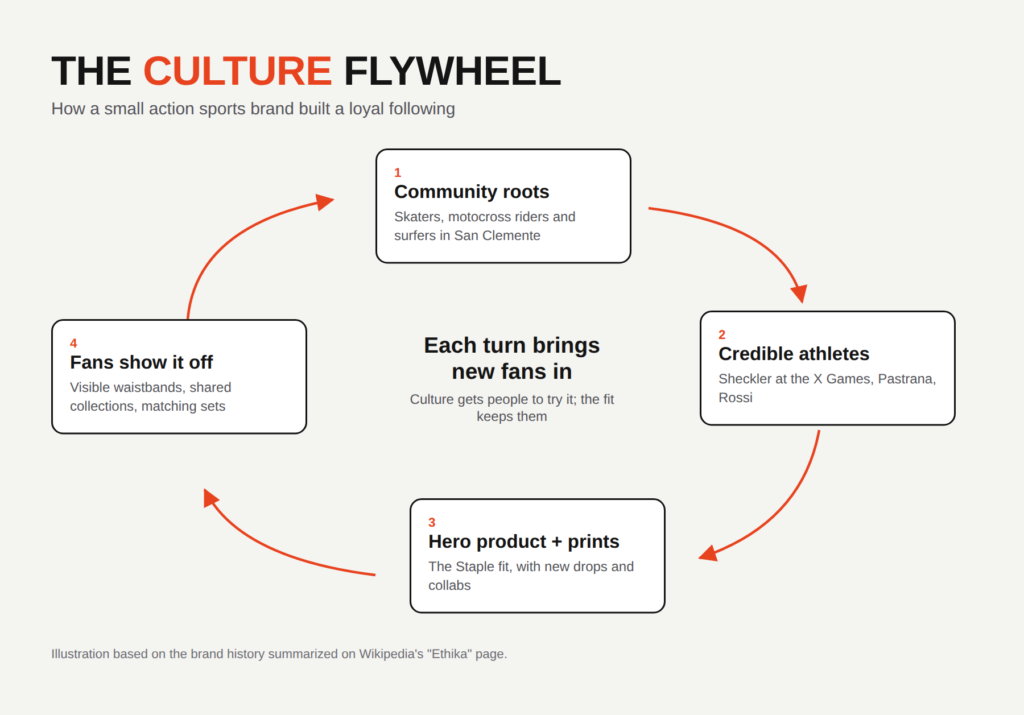
Ethika’s early marketing was about as grassroots as marketing gets. The brand put stickers on skateboards and dirt bikes, getting its name in front of the riders whose opinions mattered most to its audience (Wikipedia).
That approach paid off in a very visible way. Skateboarder Ryan Sheckler wore Ethika at the X Games at just 13 years old, putting the brand in front of a huge audience of young action sports fans. For a small company, it was the kind of exposure money can’t easily buy, and it came from inside the culture rather than from a traditional ad campaign.
This is a pattern you see again and again in action sports and streetwear. Credibility comes first from the people the community respects. A brand that’s worn by a respected rider, skater or artist earns a kind of trust that billboards can’t create.
Athletes as storytellers
As Ethika grew, its connection to athletes became central to its identity. Motorsports star Travis Pastrana, one of the most famous names in freestyle motocross and action sports, became closely tied to the brand, with his own signature line. In June 2017, Ethika released a signature collection with Valentino Rossi, the Italian MotoGP legend with a huge global following (Wikipedia).
Ethika also reached well beyond action sports. In 2015, it announced a group of athletes from mainstream American sports, including NBA players such as Klay Thompson and NFL players such as Jarvis Landry (Wikipedia). That move helped take the brand from a niche action sports label to something recognized across a much wider sports and lifestyle audience.
Signature lines matter in this world because they turn a product into a connection. Wearing a rider’s collection isn’t just about the underwear. It’s a small way of repping someone you admire, much like buying a pro skater’s board model or a basketball player’s signature shoe.
The Staple: when a product becomes an icon
Every culture-driven brand needs a hero product, the item people think of first. For Ethika, that’s the Staple, a boxer brief introduced as the “Staple Fit” in 2005 (Wikipedia).
The Staple’s defining feature is practical: a longer leg than a typical boxer brief, with a close fit through the thigh, which stops the legs from riding up during movement. Independent reviewers rate its ride-up control as one of its biggest strengths (Underwearank). That’s a genuine solution for anyone who spends the day skating, riding, training or simply walking a lot.
But the Staple also became a consistent canvas. Because the shape stays the same, the prints can change constantly. That combination, a reliable fit with endlessly changing designs, is what allowed Ethika to build a collecting culture around a product most people never think twice about.
Prints as a canvas
Walk into an action sports store and look at a wall of skate decks. Each one is the same shape, but the graphics range from minimalist logos to wild illustrations. Skateboarding has a long history of graphics as identity: the board you ride says something about you.
Ethika applied the same idea to underwear. Its catalog is known for an enormous range of prints, from camo and tie-dye to flames, florals, cartoon-style graphics and sports themes. New designs arrive regularly, some in limited runs, and fans keep an eye on releases much the way sneakerheads track drops.
This approach does a few things at once:
- It turns a commodity into a choice. You don’t just buy underwear; you pick the print that suits you.
- It creates reasons to come back. When new designs arrive often, there’s always something fresh to see.
- It encourages collecting. Limited prints and athlete collections give fans something to hunt for.
- It makes the product shareable. A bold print is something people are happy to show, which spreads the brand without paid advertising.
Action sports and the art of graphics
To understand why prints matter so much to Ethika’s audience, look at the visual culture of action sports itself.
Skateboarding has one of the richest graphic traditions in any sport. Deck graphics have been a form of art and identity for decades, with artists building entire careers on board designs. Skaters choose boards partly for their shape and partly for what the graphic says about them.
Motocross is famously colorful. Riders wear bold, coordinated gear, from jerseys and pants to helmets and bike graphics, and those kits are a big part of a rider’s image. Fans often buy gear that matches their favorite riders.
Surfing has its own visual language, from board art and wetsuit colors to the prints on boardshorts that defined beach style for generations.
Against that background, plain grey underwear looks out of place. A brand that speaks the visual language of these communities, with loud prints, rider collaborations and limited designs, feels like a natural extension of the gear people already love.
The visible waistband
None of this would work if nobody could see the underwear. That’s where streetwear comes in.
Showing a branded waistband above your jeans or joggers isn’t new. It’s been part of streetwear and fashion for decades, and designer underwear brands built entire campaigns around it in the 1990s. What changed with brands like Ethika was the scale of self-expression. Instead of a plain logo band, the waistband and the print became part of the outfit.
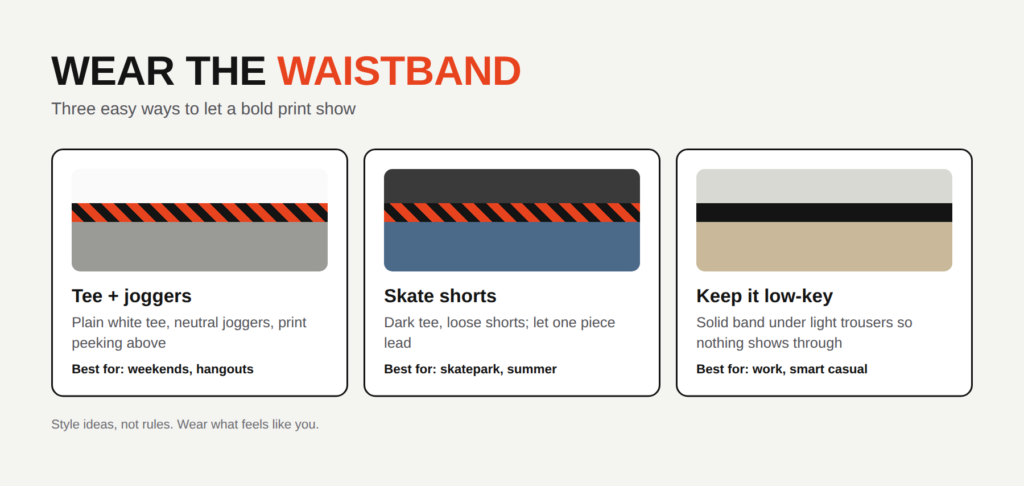
Today, a peek of a bold print above low-slung joggers or skate shorts is a familiar look at skateparks, gyms and casual hangouts. The underwear is no longer hidden; it’s a layer of the outfit, like socks or a cap.
Inside drop culture
“Drops” are limited releases of new products, announced and released at a specific time. They’re common in sneakers, streetwear and collectibles, and they’ve become part of how brands like Ethika keep their communities engaged.
Drops work because they combine a few powerful ingredients:
- Novelty. There’s always something new to look forward to.
- Scarcity. Limited runs make some designs feel special, and fans enjoy the hunt.
- Timing. A release date gives people a reason to come back and a moment to talk about.
- Community. Fans share what they got, compare favorites and trade tips.
Drop culture can be a lot of fun, but it’s worth keeping a healthy perspective. A few tips if you enjoy collecting:
- Buy what you’ll wear. The best part of a great print is wearing it, not just owning it.
- Set a budget. Limited releases are designed to create urgency. Decide in advance what you’re comfortable spending.
- Know your size first. Limited items are harder to swap, so get your fit sorted on everyday pairs before chasing drops.
- Don’t stress about missing out. New designs keep coming. There will always be another print you love.
Community and fandom
Part of what makes a brand like Ethika feel bigger than its product is the community around it. Fans share photos of new prints, show off their collections, and put together matching sets for friends, partners and families. Teams, riding crews and friend groups sometimes pick a shared print for a trip or an event.
That kind of organic sharing is valuable for any brand, but it only happens when people genuinely enjoy the product. It’s the difference between marketing to a community and being part of one.
Why the fit keeps people coming back
It’s tempting to explain Ethika’s success purely through culture: the athletes, the prints, the drops. But culture alone rarely keeps customers for years. The product has to work.
For many fans, the Staple’s practical benefits are what turned a first purchase into a habit. A long leg that doesn’t ride up, a wide waistband that stays flat, and four-way stretch that moves with you solve problems people feel every day. Once someone has found underwear they never need to adjust, they tend to stick with it.
That’s the real lesson. The culture gets people to try the product, and the product gives them a reason to stay.
Growing up: women’s and youth lines
A brand that’s built around a single audience eventually hits a ceiling. Ethika expanded its reach by launching a women’s line in late 2015 and adding a youth line for kids (Wikipedia). It organized its range into lifestyle, performance and premium lines, giving different customers different entry points.
The family-wide approach also fit the brand’s print-driven identity. When the same bold designs are available for men, women and kids, matching prints become a fun idea for couples, families and teams, especially as gifts.
Distribution followed the culture, too. Alongside its own website, Ethika has been sold through action sports retailers such as Zumiez and Tillys, putting it in front of exactly the young, style-conscious shoppers who were already buying skate and surf brands (Wikipedia).
“With You Everywhere”
Ethika’s tagline is “With You Everywhere,” and its own description of the brand emphasizes authentic experiences, creative innovation, self-expression and quality products. It’s a neat summary of the strategy. Underwear is literally with you everywhere, from the skatepark to the office. The brand’s pitch is that it should be comfortable enough to forget about and expressive enough to enjoy.
That dual promise of function and personality is common to many successful streetwear brands. The product has to work, or the community will drop it. But it also has to mean something, or it’s just another commodity.
Ethika at a glance
Here are the key moments in the brand’s story, from its founding to today.
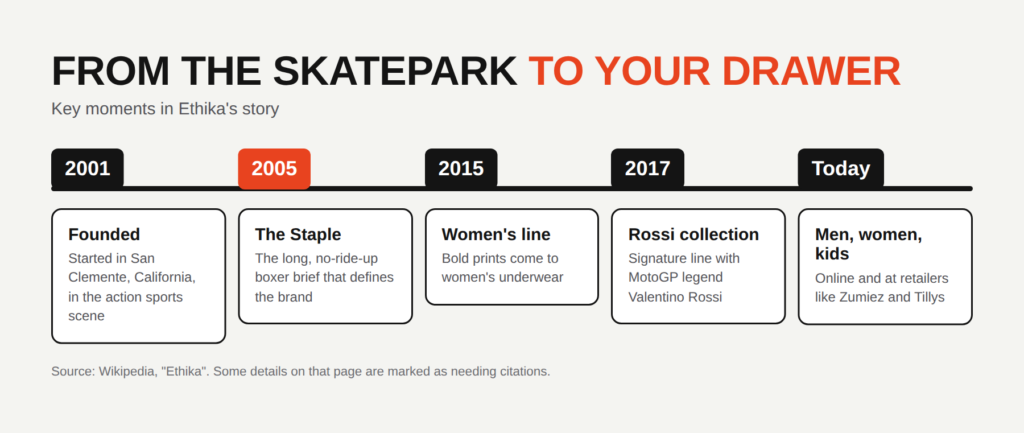
- 2001: Ethika is founded in San Clemente, California.
- Early 2000s: stickers on skateboards and dirt bikes; Ryan Sheckler wears Ethika at the X Games as a teenager.
- 2005: the Staple Fit is introduced, the long boxer brief that becomes the brand’s signature.
- 2015: Ethika announces a roster including NBA and NFL players, and launches its women’s line late in the year.
- 2017: a signature collection with Valentino Rossi is released.
- Today: men’s, women’s and youth lines, sold online and through retailers such as Zumiez and Tillys.
Five lessons from the Ethika playbook
Whether or not you wear Ethika, the brand’s rise offers useful lessons for anyone building a product, a brand or a community.
1. Start inside a real community
Ethika didn’t try to appeal to everyone at first. It started with skateboarders and motocross riders, earned their trust, and expanded from there. Narrow beginnings often build stronger foundations than broad ones.
2. Let credible people tell your story
Stickers on boards and a teenage skater at the X Games did more for early awareness than a conventional campaign could have. The people a community already respects are the most persuasive messengers.
3. Build one hero product
The Staple gave Ethika a clear identity. When people talk about the brand, they talk about one product with one clear benefit: it doesn’t ride up. A hero product makes a brand easy to recommend.
4. Keep the base steady and the surface fresh
A consistent fit with constantly changing prints gives customers both reliability and novelty. They know what they’re getting, but there’s always something new.
5. Make it shareable
A plain product is easy to forget. A product people want to show off spreads itself. Ethika’s prints and visible waistbands turned customers into walking advertisements, by choice.
How the brand speaks
Tone matters as much as product in culture-driven brands. Ethika’s voice leans into energy and attitude rather than clinical product claims. Its imagery tends to feature riders, athletes and creators in motion, not models standing still in a studio. Prints are named and themed in ways that feel playful, and the overall feel is closer to a skate brand than to a department store underwear aisle.
That consistency matters. When the tone of the marketing, the look of the product and the people wearing it all line up, a brand feels authentic. When they don’t, audiences notice quickly, especially in communities as tight-knit as skateboarding and motocross.
The trade-offs of a culture brand
No brand is perfect, and a balanced look includes the trade-offs.
- Premium pricing. Independent reviewers put the Staple at roughly $25 a pair (Underwearank), more than basic multipacks. Part of what you pay for is design and brand.
- Warmth. Dense stretch fabrics can run warm. Underwearank rated breathability as Ethika’s weakest area (Underwearank).
- Bold isn’t for everyone. Loud prints are central to the brand. Solids exist, but if you want quiet basics, other brands focus more on them.
- Support. Some reviewers note the pouch has less shaping than support-focused brands, so it may not suit everyone’s needs.
For fans, these are usually acceptable trade-offs. But they’re worth knowing if you’re deciding whether the brand fits your priorities.
How to collect and wear statement underwear
If you’re drawn to the culture side of Ethika and brands like it, a few tips help you enjoy it without it feeling like a costume.
Build a rotation
Start with a handful of everyday solids or subtle prints for days when you want something low-key, then add statement prints you genuinely love. Think of it like a sneaker collection: a few beaters for everyday wear, a few favorites for when you want to stand out.
Match the print to the moment
Wild graphics shine at the skatepark, the gym or a casual hangout. Under light-colored work trousers, bright prints can show through, so solids or subtle patterns are the safer choice.
Let one piece lead
If your waistband or print is meant to be seen, keep the rest of your outfit simpler. A plain tee and neutral joggers let a bold print do the talking.
Look after your favorites
Prints and stretch last longest with gentle care: wash cold, inside out, skip fabric softener and avoid high heat in the dryer. A limited print you love is worth an extra minute of care.
Underwear, streetwear and self-expression
Ethika is part of a broader shift. Over the past few decades, categories that were once purely functional, such as socks, caps, sneakers and underwear, have become vehicles for personal style. Graphic socks, limited-edition sneakers and collectible caps all follow the same logic: an everyday item becomes a way to say something about who you are.
Action sports played a big role in that shift. Skateboarding, surfing and motocross have always mixed athleticism with visual identity, through board graphics, wetsuit colors and helmet designs. When brands from that world turned to everyday clothing, they brought that sensibility with them.
Underwear might seem like an unlikely place for self-expression. But for many people, the clothes nobody else sees, or that only a few people see, are where they feel freest to have fun.
What other everyday products can learn
The same approach could apply to almost any everyday basic. Socks have already gone through a similar transformation, with graphic and limited-edition designs now common. Caps, phone cases, water bottles and even kitchen basics have all found ways to become personal and collectible.
The ingredients tend to be the same:
- a product that does its job better than the default,
- a consistent base that people can rely on,
- a constantly refreshed surface, whether that’s prints, colors or collaborations,
- and roots in a real community whose members carry the story.
Ethika is a clear example of all four in a category most people never thought could be interesting.
A streetwear glossary
If you’re new to streetwear and drop culture, here are a few terms you’ll hear often:
- Drop: a scheduled release of new products, often in limited quantities.
- Collab: a collaboration between a brand and an artist, athlete or another brand.
- Signature line: a collection designed with or named after a specific athlete or creator.
- Colorway: a specific combination of colors on a product. The same design can come in several colorways.
- Grail: the item a collector wants most, often rare or discontinued.
- Restock: a new batch of a product that previously sold out.
- Waistband flex: slang for intentionally showing a branded or printed waistband above your pants.
What comes next
It’s hard to predict exactly where any brand goes next, but the trends that helped Ethika are still going strong. Comfort-first clothing, athletic wear in everyday settings, limited drops and athlete-led collections are all part of how younger shoppers buy. Brands that combine a product that genuinely works with a strong cultural identity are well placed to keep their communities engaged.
For fans, that likely means more of what they already enjoy: new prints, new collaborations and a fit they can rely on.
Why this matters to shoppers
Understanding a brand’s story isn’t just trivia. It helps you shop smarter. A brand born in action sports will usually prioritize movement, stretch and ride-up control. A brand built on prints will usually offer more variety and more frequent releases. And a brand whose community values authenticity tends to stay close to what its core customers want.
Knowing that, you can decide whether a brand’s priorities match yours. If you want underwear that stays put during an active day and lets you have some fun with style, a culture-driven brand like Ethika may suit you well. If you want the quietest, coolest basics at the lowest price, you might look elsewhere.
Frequently asked questions
Where is Ethika from?
Ethika was founded in 2001 and is based in San Clemente, California, a coastal town in Orange County known for its surf and action sports culture.
Who founded Ethika?
Malcolm McCassy is credited as the founder. The brand also has close ties to action sports athletes such as Travis Pastrana and Ryan Sheckler.
What is Ethika best known for?
Its Staple boxer brief, a long-leg design introduced in 2005 that’s known for not riding up, and its huge range of bold prints.
Which athletes have worked with Ethika?
Ethika has been associated with action sports stars such as Travis Pastrana and Ryan Sheckler, released a signature collection with MotoGP legend Valentino Rossi in 2017, and in 2015 announced a roster that included NBA and NFL players.
Does Ethika make women’s and kids’ underwear?
Yes. Ethika launched a women’s line in late 2015 and also has a youth line.
Where is Ethika sold?
Online through its own website and through action sports retailers such as Zumiez and Tillys.
Why do people show their underwear waistbands?
A visible waistband has long been part of streetwear style. With print-driven brands like Ethika, the waistband and print become part of the outfit, a way to add personality to a simple look.
Is Ethika underwear good for sports?
The brand grew up in action sports, and the Staple’s long leg and four-way stretch are designed to stay put during movement. Some fabrics can run warm, so lighter options suit hot weather better.
Is Ethika a skate brand or an underwear brand?
Both, in a sense. Ethika is primarily an underwear and lifestyle brand, but its identity was shaped by skateboarding, motocross and surf culture, and it still draws heavily on that world.
Why are Ethika prints so popular?
They borrow from the graphic traditions of action sports and streetwear, change often, and include limited designs and athlete collections. That makes them fun to choose, collect and show off.
Is Ethika the same as Ettika?
No. Ethika, spelled with an “h”, is the San Clemente underwear brand. Ettika is an unrelated jewelry brand with a similar-sounding name.
The bottom line
Ethika’s story is a reminder that even the most ordinary products can carry culture. A small brand from a California surf town took a commodity, gave it a fit that genuinely works, wrapped it in the visual language of skateboarding and streetwear, and let the people its audience admired tell the story.
The result is underwear that people collect, show off and talk about, which is a remarkable thing for a category that was once sold almost entirely in plastic three-packs. Whether you’re a longtime fan or just curious, it’s a fascinating example of how function, community and self-expression can come together in the most everyday of places.